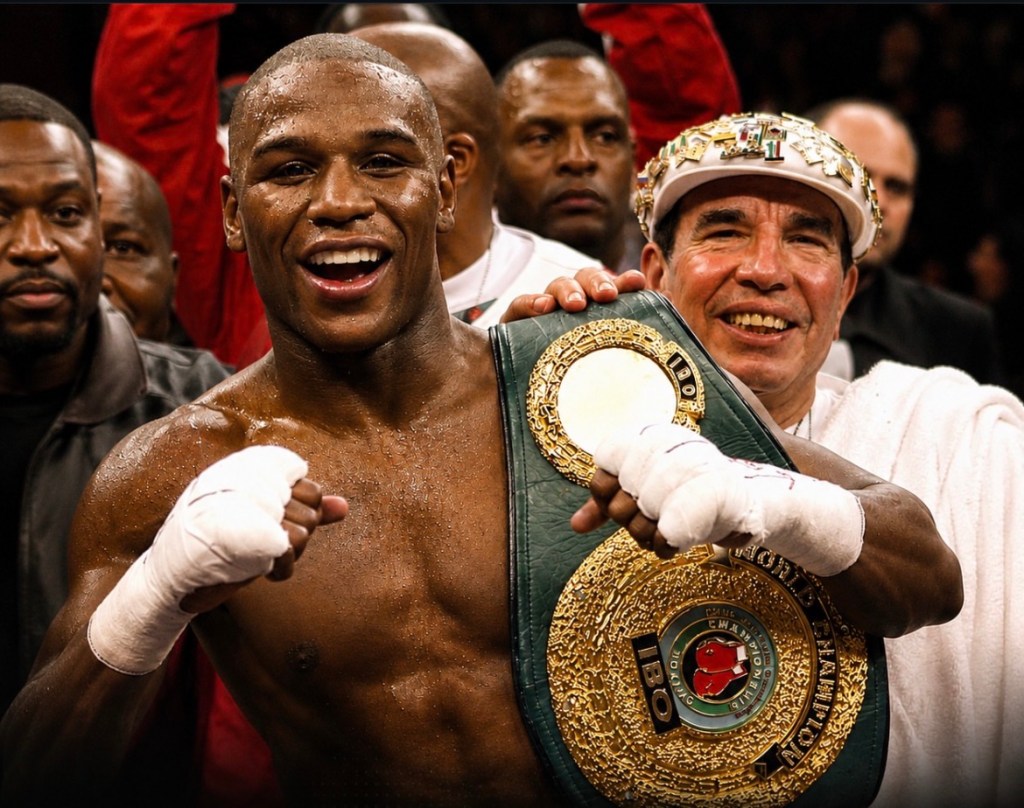
Image credit: @iboboxingofficial via Instagram.
In boxing, sanctioning bodies award and regulate championships by establishing rankings for each weight division. They essentially oversee professional boxing by creating a framework of rules, crowning champions and enforcing mandatory fights for those champions. They often play the role of the villain, due to boxing’s famed political problems.
They also like to make a pound note, often being seen as usurping their own rules in order to reward more commercially viable fighters instead of enforcing a meritocracy where championship fights are earned through just skill.
We’re in the four belt era. This is a period of time where there are four major sanctioning bodies, the WBA, WBC, IBF and WBO, who each award their own world championship title in every weight division.
These four governing bodies all recognise each other, and often work in tandem to crown unify champions.
However, outside of the four major ones, there are further sanctioning bodies.
The History of the IBO
The International Boxing Organization (IBO) was founded in 1988, and incorporated in 1992. This was around the same time that the WBO was founded, so their exclusion from recognition amongst the major sanctioning bodies isn’t age-related.
It took the WBO approximately 19 years to become fully-recognised,with their belt then being required for a champion to be undisputed within their weight class.
Despite charging lower sanctioning fees than other bodies, with 38 years passing since the IBO’s founding, it looks more than likely that they’ll never be recognised by the other sanctioning bodies.
How The IBO is Different
Towards the end of the 1990s, the IBO implemented a then-groundbreaking computerised ranking system. They called this ‘The Independent World Boxing Rankings’. The purpose of this was to remove the subjective elements from rankings. With a view to making the sport more credible and legitimate, wide adoption of their independent rankings would’ve reduced finances as a factor in how championship fights were made and made the sport more meritocratic.
Fighters would’ve earned their positions through results and quality of opposition, rather than relationships with promoters, managers or sanctioning officials. Consequently, champions would be more likely to face the genuinely highest-ranked available contenders, rather than opponents elevated through questionable rankings.
There would’ve been fewer politically motivated rankings, which still ail the sport to this day.
Following Usyk’s decision to vacate the WBA Heavyweight Championship, it would be reasonable to conclude that Murat Gassiev’s Regular Heavyweight Championship, which he won and has successfully defended in the ring, should be upgraded to full champion status.
At the very least the championship should’ve been awarded to the winner of Gassiev’s next bout.
Instead, the WBA have decided to bypass Gassiev and award their Super Heavyweight Championship to the winner of Fury/Joshua in December, a decision most-definitely motivated by the prospect of lucrative sanctioning fees rather than sporting merit.
John Wirt, co-promoter and legal counsel for Gassiev, gave an interview to IBA sport in which he highlighted that “If anyone should be fighting for the WBA Super heavyweight title, it is Murat Gassiev, the reigning champion, not two boxers who currently hold no world title between them.
Allowing the WBA’s number two and number three contenders to bypass the number one contender and the reigning champion himself would be an extraordinary and, to our knowledge, unprecedented decision.”
The IBO’s independent computerised system could’ve helped eliminate situations like this.
Where They Fall Down
The IBO does not enforce mandatory title defences for their champions. This is widely believed to be due to them believing that champions should have greater freedom to make competitive, meaningful fights rather than being obliged to face a particular challenger.
However, in actuality, this means that championship fights can be sporadic and champions have bouts of inactivity between defences.
Furthermore, without mandatory challengers, talented but relatively unknown contenders can struggle to secure world title opportunities. This could be seen as contradicting the IBO’s mission of making boxing more credible.
In order to improve their own credibility, The IBO will also often simply look to attach their vacant titles onto existing championship bouts contested for the recognised titles. Fighters are happy for them to do this as it allows them to win another belt, even if it’s a fringe one.
It also raises the IBO’s profile, with its belt frequently pictured alongside those of other sanctioning bodies following a fighter’s unification victory.
Boxing’s Problem with Championships
Championships are important for boxing. Titles should allow fans to quickly understand who the best fighter is in a division, and create a single point of ascension for boxers to aspire to reach. They make fights bigger.
In the contemporary boxing landscape, things aren’t quite like that. More and more, fighters are led by money rather than accolades.
Who am I to judge? I am not the one risking my health in the pursuit of greatness.
However, this is diminishing the importance of championship belts.
What’s also compounding this is the sheer volume of champions that exist. Having multiple champions across several sanctioning bodies isn’t particularly fan-friendly because it makes following the sport more confusing and dilutes the prestige of being a world champion.
For example, if we look at the Cruiserweight division.
David Benavidez is the WBA and WBO World Champion. Michal Cieslak is the WBC World Champion. Jai Opetaia holds the Zuffa World Championship, as well as the Ring Magazine championship. The IBF championship is currently vacant.
Juergen Uldedaj is the current IBO champion. This means that there would be 7 different world championships for the 200lb division if the IBO was to become more widely recognised.
Pure madness.
The four major sanctioning bodies also have secondary championships, like the WBC’s Silver or the WBA’s intercontinental titles. The purpose of these belts is to provide additional pathways towards world title contention, recognise emerging talent and create further opportunities for sanctioning bodies to generate revenue through additional title fights.
This only adds to the confusion, further diluting the prestige of a world championship and making it increasingly difficult for casual fans to distinguish between the best and the rest.
So, Should The IBO be Recognised?
The IBO lacks the historical prestige, commercial influence and widespread industry recognition enjoyed by the major sanctioning bodies. Its limited adoption by major promoters, broadcasters and boxing commissions has also made it harder to establish itself as an equal to the four established bodies.
Whilst ‘The Independent World Boxing Rankings’ was ahead of its time, time waits for no man. It’s no longer groundbreaking. So much so that the IBO has widely abandoned it itself, instead believed to use BoxRec in order to rank fighters in each weightclass.
On the other hand, IBO titles have been held by some of the greatest to ever do it in the modern era, including Lennox Lewis, Floyd Mayweather Jr, Oleksandr Usyk, Gennady Golovkin and Manny Pacquiao to name just a few. The championship belts themselves are beautiful. Regal, in fact.
However, the IBO is not alone in occupying this position: a fringe world championship belt that has nevertheless been held by some of the sport’s greatest fighters.
Between 1995 and 2009, the now-defunct WBU awarded its world titles to several elite fighters, including George Foreman, Johnny Nelson and Ricky Hatton.
There is another consideration of note – does the IBO want to be recognised? And need to conform in their operations to be inline with the four major bodies?
As Groucho Marx once said; “I don’t want to belong to any club that will accept me as one of its members”.
Please subscribe below, it’s free so don’t be a loser. I’m like tinkerbell, I need you to applaud and believe in me to survive.

